
soulati.com

Digital Marketing Strategy, PR and Messaging

  • Home
  • So What is Message Mapping ?
  • Services
  • Hire Me
  • Blog
  • Presentations
  • Get a FREE E-Book
  • Contact
  • Home
  • So What is Message Mapping ?
  • Services
  • Hire Me
  • Blog
  • Presentations
  • Get a FREE E-Book
  • Contact

Soulati-'TUDE!

Archives for October 2010

Calculating YOUR Social Media ROI

10/06/2010 By Jayme Soulati

Inspiration for blog posts comes from such odd places; I glommed on to this one as it rolled off my tongue on a call. I told a colleague Twitter had saved me from a slow death in a dark office. My love of Twitter is no secret:

A global community of intellectuals

  • New friends with whom to banter and pose odd questions

Information and collections of learning for my professional development

A network of experts on chats, like #SBT10 with whom to ask basic questions without fear and so much more.

My colleague then said, “You be careful, Jayme. I hope you’re making money as a result?” And, I said, “Nope, I haven’t asked. ROI on Twitter isn’t always about money.”

That’s when I realized the nugget for this post. How do you define your social media ROI? Forrester  is selling a report with nearly the exact same title. (Promise, I didn’t know it until seeing the direct e-mail in my box after I wrote my headline and post.)

ROI comes in various shapes and sizes.

My friend Mark W. Schaefer who writes the amazingly successful {grow} blog with a hyper-engaged community states it wisely, “There are many business benefits that come from Twitter. It could be information, competitive intelligence, a new supplier or partner, a deal, a link, or yes, even a sales lead.” (I encourage your perusal of this link to Mark’s blog regarding his post today about the power of Twitter consumers.)

Defining ROI is usually akin to financials i.e. revenue and profit. For me, social media (Twitter and blogging) have always been defined as brand development and thought leadership. One would argue these are metrics… exactly…because return on investment is about measurement via metrics that may not always directly correlate with the bottom line and profitability. 

If you’re a SMB (small-to-medium business), determining how social media influences your business is easier to ascertain, and you can create your own value-based metrics that align directly to your business model and culture.  

How about these as examples:

  • A re-tweet 40 times of a blog post announcing a product or service leads to five inquiries on your Web site. (That’s ROI.)
  • A new person you met on Twitter becomes your next employee because you developed rapport, engaged in conversation over time, and took a chance on hiring. You saved money with no job listings, no recruiters, and communicated directly with the candidate. (That’s ROI.)
  • A blog post written by someone at the company garnered a call by a respected partner in your vertical market interested in collaborating on an upcoming project. (That’s ROI.)

I may’ve backed myself into somewhat of a corner trying to define ROI via measurement values versus dollars, but who are we to tie a bow around a box and define it traditionally? Social media has spawned out-of-the-box thinking and so, too, should it pave the way for  creative definitions of ROI suited to your business.

However, when you’re not the boss, perhaps it’s safer to get out the box with the pretty ribbon?
Filed Under: Social Media Strategy Tagged With: Measurement, ROI, Social Media

Social Media, PR and Greenpeace

10/05/2010 By Jayme Soulati

Credit: Greenpeace

Here’s a brand everyone loves to hate or loves to love. Regardless of your perspective, you’ve got to admire how is using social media and grassroots marketing for its cause.

Earlier this year, I wrote several times and about the palm oil debacle. The world watched as a video went viral (in this case I prefer to use “viral” versus “word-of-mouth”). It included the bloody end of an orangutan finger posing as a Nestle Kit Kat chocolate bar (bitten by an unsuspecting actor).

My posts captured the situation as it unfolded – the non-profit taking on the likes of global behemoths (along with Unilever, Burger King, Pizza Hut, KFC, and the list goes on and on) about of the rain forest by palm-oil manufacturer Sinar Mas. I read coverage in the Wall Street Journal that announced a third-party audit by Sinar Mas to clear its name only to have a comment on my blog inform me the report was fraudulent.

For as long as I can remember, Greenpeace has capitalized on every marketing and public relations tactic available to push its message to the masses and take on corporate America. Last week in the Denver airport, I was greeted on the main concourse by two Greenpeace volunteers. These kids were early 20s, and the woman I spoke with was buoyant and engaging with piercings in various facial places and spiky black hair (just sayin’).

She and her buddy were doing grassroots marketing in a high-traffic location to engage folks in the their cause – to save the rain forest by “outing” corporate America’s massive use of palm oil. I informed her I had blogged twice when the group took on Nestle and Unilever; I also opined the Greenpeace  viral video was vile. (At that she looked a bit sheepish.)

She asked if I had visited its Web site to see what they were doing, and she asked me to join its cause.

I respectfully declined saying I intended to stay neutral until I was more informed, although I was likely the most-informed passerby that whole day. Had I made a donation to Greenpeace then or registered to join its cause, I knew I would need to also alter purchasing from the corporate giants Greenpeace disdains. I wasn’t ready to make that change nor did I want to be a hypocrite.

I am suitably impressed by the audacious, activist, committed, aggressive public relations by Greenpeace. I’ve watched it unfold since the beginning of my PR career more than two decades ago.  Look at the Greenpeace model:

  • It adopts a cause and uses every tier and tactic of marketing communications powered now by social media.
  • By adopting social media, Greenpeace has hit more than just pockets of activist- oriented and like-minded consumers; it has filtered its message through the masses on blogs, Facebook, Twitter and My Space.
  • It has not ignored tried-and-true grassroots marketing – the face-to-face interpersonal communication at airports in which its headquarters resides, for example. It collects names, commentary, memberships, registrations, subscriptions, and donations one by one, just like a political campaign.

For any company and not-for-profit seeking tips how to implement marketing tactics with the aplomb of Greenpeace, head to the Denver Airport for a reminder.

Filed Under: Public Relations, Social Media Strategy Tagged With: Greenpeace, PR, Social Media

Calculating Media Impressions

10/04/2010 By Jayme Soulati

Back in the day, we measured ROI of a public relations campaign with media impressions. We took a story in the daily newspaper and multiplied the circulation by 2.65 (the number of people we believed read a paper including pass-along rate). That’s how the total number of media impressions was calculated and how the success of a story placement or “hit” was determined.

This equation is still in force today; however, the number of people actually reading a newspaper today is lower and suspect. How can we be sure the headline and lead aren’t the only two pieces of a print story to garner attention?

The other way we measured ROI was to calculate column inches for a story to determine how much ink our placement secured.  Other ways we gauged success was to look at story content, tone, quotes, etc. These measurement tactics for traditional media relations haven’t changed, but the two PR ROI calculations for impressions and ink are archaic.

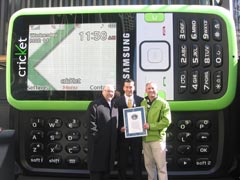
Yet in today’s Wall Street Journal, I was astonished to see “media impressions” used to describe the success of a campaign by Cricket Communications and Samsung Electronics to open new markets with the “world’s largest fully functioning cell phone, the Samsung Messenger ( 15’ x 11’ x 3’).” Not only did this stunt garner “38 million media impressions (the number of people who may have seen an article, heard something on the radio, watched something on TV, or read something on the Web),” it was entered in the Guinness Book of World Records by payment of nearly $5,000 to make the event official with a judge.

Nowhere in the story today is there mention of social media ROI to calculate campaign success; palpable.

If marketing is inviting public relations to the table to brainstorm events not yet designated world records by Guinness World Records, Ltd., shouldn’t social media as a bona fide strategy be included to calculate campaign success?

Filed Under: Public Relations Tagged With: Media Relations, Public Relations

Twitter: Why Do You RT?

10/01/2010 By Jayme Soulati

This week, several Re-Tweets of a tweet I RT’ed provided fodder for a blog post oriented to thinking before clicking to RT someone else’s content. I didn’t know it would resonate as it did; it also prompted additional thought on re-tweeting as a practice.

(Just a note here for those not as engaged on Twitter — I absolutely LOVE Twitter for the wealth of relationships, training, community, and engagement it has provided me. Twitter has absolutely changed my professional life.)

Why do you re-tweet?

People re-tweet to:

  • Give credit (as per Jenn Whinnem in the comments to said post above) and as a goodwill or friendly gesture to pals in your tweet stream.
  • Recognize the originating author’s content, such as a blog post.
  • Share news of the day relevant to an entire stream of tweeps (that’s short for people who tweet).
  • Get attention by the originating author as a pal to include in their stream.
  • Raise the bar on a brand (usually one’s own) as a reputable source for content.
  • Share studies, data, pontificating with others interested in the same topics/themes.
  • Send along hot news so you don’t have to find it yourself.
  • Build link love (to a lesser extent)

Re-tweets are so commonplace that rarely do we think about why we do it. Nor, as above, do we check links before sending tweets along. Sometimes that can be a disaster especially if content is a bit weak and no one takes time to read an entire story.

I know in the past I’ve been guilty of doing a bit of buttering up when I RT, but that’s when I was building my stream and creating a brand. That’s probably not anything to feel guilty about, really; it’s what Twitter is supposed to be about, right?

Twitter helps people:

  • Build a brand
  • Create a community
  • Engage with folks of like minds or not
  • Push and pull data and info
  • Monetize (to a lesser extent) and provide value with measurement

So, why do you RT and do you think before clicking send?

Filed Under: Social Media Tagged With: Twitter

« Previous Page
ALT="Jayme Soulati"

Message Mapping is My Secret Sauce to Position Your Business with Customers!

Book a Call Now!
Free ebook

We listen, exchange ideas, execute, measure, and tweak as we go and grow.

Categories

Archives

Search this site

I'm a featured publisher in Shareaholic's Content Channels
Social Media Today Contributor
Proud 12 Most Writer

© 2010-2019. Soulati Media, Inc. All rights reserved. Dayton, Ohio, 45459 | 937.312.1363