soulati.com

Digital Marketing Strategy, PR and Messaging

  • Home
  • So What is Message Mapping ?
  • Services
  • Hire Me
  • Blog
  • Presentations
  • Get a FREE E-Book
  • Contact
  • Home
  • So What is Message Mapping ?
  • Services
  • Hire Me
  • Blog
  • Presentations
  • Get a FREE E-Book
  • Contact

Soulati-'TUDE!

Analytics Make Social Marketing Complex

04/18/2012 By Jayme Soulati

I just read John Obrecht’s opinion column in BtoB April 9, 2012 on Thriving in the Age of Complexity. He shares how marketers’ bane is the complexity of social media marketing; trying to teach everyone and give them the tools to dive in while mastering the complexity of all the channels, not to mention the ROI of it all.

Indeed. And, he got me thinking; always dangerous.

There are all those lovely back-end numbers hidden from view that people call analytics. They comprise those data-driven reports that many   people salivate over. Analytics make Google rich, and they make me suspect. Are those numbers real or skewed? Did you really get that many people to your webinar? How many qualified sales leads downloaded that white paper off that new landing page you just developed and published?

How about if I go to Clicky and see that 10 people from Canada and 80 from The Netherlands (because I was writing about Dutch tulips) read a post I wrote and stayed on my page three minutes. What can I do with that information? Should I keep on writing about flower bulbs from Holland which is not my primary expertise or service offering to satisfy higher analytics? Or, should I come back to center and write about   which everyone seems to want to know more about (based on analytics reports I see on occasion).

I was talking this week to a colleague being asked to drum up numbers from a few years ago to justify the success of various marketing campaigns. Why? I’m thinking the people at the quarterly meeting don’t care much about what happened in the past; they’d likely prefer to know which marketing campaign is planned for the future with how many built-in touches and success metrics.

The need for proof points, data, numbers that say W00t! and other analyses that contribute to complex interpretation with nary a consensus makes me cringe.

My PR measurement peers will smack me around when I say that, so let me clarify. I like to prove my program worked; I love to have solid and measurable results that support my strategy and help me earn my keep. But, there are many unnecessary layers of analytics blanketing a creative campaign that most practitioners can’t deep dive into for lack of where to start and how to skin the cat.

Just read John Obrecht’s column. He references a bunch of marketers at Digital Edge Live, an industry show, who “are charged up about their work,” despite massive upheaval and the generation of “big data.”  Obrecht’s conclusion, though, calms nerves; “Despite all the complexity, this does indeed seem the best of times to be a marketer. It’s that simple.”

What do you think? When was the last time you used an analytics report or data to prove your campaign or support a new approach? Was it a one-off situation or do you frequently abide by analyses to win consensus? Is your company or website generating mass amounts of data you can’t begin to decipher?

Here’s my conclusion… Do embrace the analytics to an extent, but keep your distance. Too many numbers is like having too many cooks in the kitchen. I’m impressed with numbers, and I’m even more impressed with someone who can work them. We all know that a good analyst can make numbers work for just about anything, but, a one-time analysis that proved a campaign was successful last year doesn’t help me tomorrow.

This post today? Everyone can argue I’m dead wrong; there are so many others saying and publishing the opposite who live and die by analytics – SEM anyone?




Filed Under: Marketing, Thinking Tagged With: Analytics, data, social marketing

13 Tips To Create Remarkable Content

04/12/2012 By Jayme Soulati

Everywhere I read, I see this word, “remarkable.” I believe it’s launch into stardom began with Seth Godin; I’m giving him that credit anyway. In a book I’m reading on Inbound Marketing by Hub Spot, the authors substitute “remarkable” for “unique.”

Be remarkable = be unique.

We’ve all spoken about the echo chamber. Today, I read four iterations on the same topic in re Instagram and Facebook. Each was different, but were they remarkable? I think remarkable is in the view of the reader; I’ve not seen a checklist for remarkable writing, have you?

All Bloggers Are Unique

Over at Erica Allison’s house I wrote a guest post about my learnings from a post I wrote on pink slime. It wasn’t received as expected, so I learned and wrote about it. In comments on that post, Michelle Quillin of New England Multimedia and Erica each suggested there’s a graciousness that comes when I stick my neck out with opinion while watching the sparks fly. Somehow, I re-position and opine again, but I have this eagerness to be current and on top of issues that are unfolding in real time.

Erica said she perhaps misses the boat on hot-button issues because she fact finds and analyzes and ensures she has an opinion based on proof points. Then she sits to write her post that takes a deep dive into the vortex.

Who’s remarkable? Neither. I’m a risk taker and she’s not; I share opinion based on wide review of readings and not supported by finite fact. I source a national story and go from there. Erica finds all the information until she can substantiate her content and button it all up.

So, is it possible to develop remarkable content? Unique material that no one else is writing about? Nope, I don’t think so, but we can at least strive to take a remarkable approach — a new and singular angle, be the first out of the gate with thoughts, be strong and confident in statements sprinkled with proof points and facts cited by reputable sources.

Is this remarkable? Nope, it’s smart.

If someone has told you bloggers have to create remarkable content to stay published or go national or get ranked on a list, that’s bogus. On the flip side, if someone, named Jayme Soulati, shared this list of smart tips for bloggers who strive to be remarkable, I’d say that’s #RockHot:

13 Tips to Create Remarkable Content

1.Read, read, read all the national publications you can get your hands on for current events, stories on an industry, material that interests you.

2. When a story appeals to you as blog fodder, tear it out! Jot a note in the margin with the story idea so you don’t lose it. (I wrote five pitches to a client for blog posts; when I opened up Smart Money, two of the  topics were featured stories in the magazine! So, trust your instinct about topic development.

3. Do not read your favorite bloggers every week and expect they will deliver current news. You need to get your news from journalistic sources along with your favorite bloggers.

4. Once you’ve learned the style and voice of your favorite blogger, you might be able to glean a bunch of current news from their writings. Is it credible, cited, sourced, trustworthy? Some bloggers will dive into an issue (I’ve seen Shonali Burke do this stunningly well), and you can trust it’s the real McCoy. Gini Dietrich always provides current news with a twist; you can find her over at Spin Sucks.

5.  Take a story that interests you — perhaps it’s the Zimmerman case unfolding as we speak or the new trial of John Edwards set to begin shortly, or the issue of transgenders being permitted to compete in the Miss Universe pageant, or women still barred from the Masters — and follow this issue with all the nuggets of information.

6. Form an opinion about a current event that is based on proof points, supporting evidence, documentation, citations, and, most importantly, your impression.

7. Write about it. Tell your community you’re going to follow this issue as it unfolds and ask them to follow with you. Get thoughts that percolate in the community; ask for opinions and honor them.

8. Honor your community’s emotions and take their pulse. Ponder all types of commentary. If you’re fortunate to have a community like the one here, the comments are not banter; they are thought-provoking and stimulating.  Not sure how I, queen of banter, have been able to develop such an intelligent community, but I’m grateful!

9. Craft and mold these insights into deeper, more remarkable content that has been “community-sourced.” I learn so much more in comments than I do just writing unilaterally. If you haven’t cultivated a community, let me know, and we’ll see about making that happen for you…not sure how I do it, it just happens.

10. Ensure your content is sprinkled with links to  your favorite bloggers or others with content you need to support you. Cite other sources that are reputable and provide background information as proof points for your opinions.

11. Publish regularly and before  you do, DO NOT read your favorite blogger and then go write your story! Write your story first and then go read the A-lister and see if you can include a link in your post.

12. So much of blogging is about trying to be original, authentic AND remarkable in an echo chamber amongst millions of bloggers striving for the same. When you hit your stride and find your voice, then you will surely begin to feel remarkable.

13. Embrace the ebb and flow of life and know that life happens. Blogging is a journey, and it perfects with time and practice. If the need arises, go dormant awhile and reawaken  your mojo. I promise, it will come back.

So, how do you create remarkable content? Simple; by creating a remarkable you.


Filed Under: Blogging 101, Thinking Tagged With: Being remarkable, Remarkable, Seth Godin, Tips

Facebook Owns Instagram: Will You Stay?

04/11/2012 By Jayme Soulati

Before I start reading everyone else’s blog (Danny Brown’s just arrived in the box) post about Instagram to sway my opinion, I’m going to just say right now in a timely way… this is all in a day’s work, right?

  • Companies buy competitors to enhance offerings
  • They buy sexy upstarts to be sexier themselves
  • They buy companies to add more customers
  • They buy companies to play in a sector they’re not
  • They buy companies just to recruit that company’s CEO (see below)
  • They buy companies that have NO revenue just because they can!

Today’s Wall Street Journal tells it like it is:

  • Instagram has ZERO, that’s a big, fat ZERO, revenue, yet it was bought for $1 billion in a CEO-to-CEO deal that did not cross the t’s or dot all the I’s.
  • Facebook says it will essentially leave Instagram independent to do what it does best (allow its 30 million users to snap images and post on various Interwebz simultaneously).
  • Facebook bought Gowalla only because it wanted that company’s CEO to come work for Facebook (did you know that?) and Gowalla ceased to exist last winter.
  • Facebook has not jumped on the mobile app bandwagon quickly enough; in fact, its ~380 million users aren’t loving or using Facebook on mobile the way Instragram users HAVE to use Instagram – it’s ONLY a mobile app.
  • Instagram users are nervous there will be charges for usage or ads that litter the landscape of the app or integration into Facebook that will forever alter the core application.

So, let me repeat something that still confounds me…Instagram has NO revenue, but it recently closed an angel investor deal just prior to its acquisition by Facebook. So, the little success story from two guys in a garage (well, really from Stanford), became a little darling much like the dot.com era where venture caps were throwing money at any dot.com that launched to see what stuck. We all know the end to that story.

So, did Facebook spend $1 billion (peanuts to them) to buy a company with zero revenue and 30 million users (many who’ve said they loved Instagram for its anti-Facebook orientation) who may drop off like flies or may not, to integrate into its own platform and ultimately knock down a potential competitor?

That’s a mouth full, for sure, and only time will tell.

I, for one, am staying with Instagram; I have never loved a mobile app so sweet, simple and launch-and-play as I have Instagram. But, let me state…after my beloved TweetDeck was taken over by Twitter and we users began to experience the pain and left in droves to HootSuite…I’m holding my breath.

Where will I go next if Facebook alters Instagram so drastically that we feel the difference? C’mon app developers, please launch the next big SnapIt, wouldja? (There, I just named your new mobile photo app, Ladies.)

And, on a final note…Instagram is FREE. It doesn’t cost $.99 to launch like many apps now do; why not? Isn’t that a paltry source of some revenue? About 30 million users at a buck each minus a cut to iTunes app store; well, that’s some source of income, right? What possesses app developers not to build in 99 cents out of the gate to at least cover some overhead?

So, what about you, Instagrammers? You comin’ or goin’?

Credit: Jayme Soulati via iPhone 4S to Instagram


Filed Under: Social Media Strategy Tagged With: Facebook, Instagram

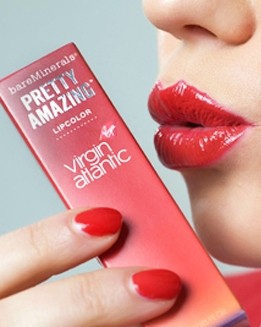
Lipstick, Virgin Atlantic and PR

04/09/2012 By Jayme Soulati

Credit: Advertising Age (adage.com)

I wear lipstick every day all day long; I love it and feel naked and drab without. So, when I read that Virgin Atlantic was launching its own lipstick, made by bareMinerals (another line I love), I was intrigued enough to write a shortie.

The announcement appeared in Ad Age “Creativity’s Top Five of the Week.” Here’s where I’m confused because the campaign feels more  like an excellently  creative PR campaign than a creative campaign from the ad department.

Look at all these elements:

  • Virgin Atlantic launches a new Upper Class Cabin and the inaugural flight from London to New York will be celebrated with a particular shade of red lipstick.
  • On the plane featuring the new elite lounge, female (why did the writers have to say “female”) cabin crew will sport the new “Upper Class Red” color of lipstick that matches their uniforms. The lipstick will contain “a special pearl powder to hydrate the lips of frequent flyers.”
  • Passengers on the inaugural flight get a free lipstick.
  • The lipstick will be sold on board or in stores that stock bareMinerals (I already know where I’m going to test this color!).

Now, my peers in public relations, does this campaign sound at all like an advertising campaign or should this one be owned by PR? Wait, I already know the answer; we’re integrated now and no one can take all the credit for a decent campaign, right?

But, still…

Filed Under: Public Relations Tagged With: lipstick, PR Strategy, Virgin Atlantic

Pink Slime Social Media Blame Game

03/29/2012 By Jayme Soulati

Credit: NorthIowaToday.com

Oh, to be a beef producer that has to slaughter 1.5 million more head of cattle and raise prices on poor consumers to accommodate retailers and school lunch programs that no longer wish to add the pink-slime-ammonium-hydroxide-laced additive that makes ground beef leaner.

And, guess who’s to blame? WE ARE!

We are the consumers who sit around all day on social media channels attacking this brand and that brand with our onslaught of detractions to effect change in the corporate world that has been doing the same thing for 20 years to unsuspecting families.

Alas. Social media is the corporation’s nemesis; well, it’s only the nemesis for those organizations that have something to hide, right?

I don’t eat red meat; I’m a flexitarian (look, Microsoft Word doesn’t even recognize that word) – I’ll eat meat on occasion, but I prefer to be a veg head – that’s what I crave (some say it’s because my blood type is A+ … the grades I got in school every day). I digress.

We’re talking about the pink slime debacle that the USDA is saying will cost…WAIT! There isn’t a cost in the Wall Street Journal article today; did that reporter fall down on his job? I bet he tried to get a price tag beyond “effectively slaughtering 1.5 million more cattle” to add to the story.

Hmm, can you put a price tag on healthier eating versus the risk of ingesting ammonium hydroxide filler in cheap cuts of meat sold by lower-value grocers to people without ability to purchase high-priced organic health foods for their families?

So, five governors in states that produce this poorly-labeled-and-pummeled (waahh) pink slime filler are lining up to defend “this unwarranted, unmerited food scare” according to the Governor of Iowa Terry Branstad alongside Texas Governor Rick Perry. They’ve both vowed to eat the product…hurray!

What’s missing from the story that also has the Nebraska governor upended is the number of jobs at risk for suspension of pink slime production (in Texas and Iowa, as well). I’m sure the reporter asked that question, too; after all, this is the Wall Street Journal reporting.

And, so, dear friends and consumers who sit around all day writing blog posts, posting detractions on social media and essentially rabble-rousing the entire population of Americans against an industry that has long functioned without consumer watchdogs…keep on. No sense crying over spilled pink milk, eh?

I, for one, applaud you.

Filed Under: Branding, Social Media Tagged With: Pink Slime, Social Media Backlash

« Previous Page
Next Page »
ALT="Jayme Soulati"

Message Mapping is My Secret Sauce to Position Your Business with Customers!

Book a Call Now!
Free ebook

We listen, exchange ideas, execute, measure, and tweak as we go and grow.

Categories

Archives

Search this site

I'm a featured publisher in Shareaholic's Content Channels
Social Media Today Contributor
Proud 12 Most Writer

© 2010-2019. Soulati Media, Inc. All rights reserved. Dayton, Ohio, 45459 | 937.312.1363